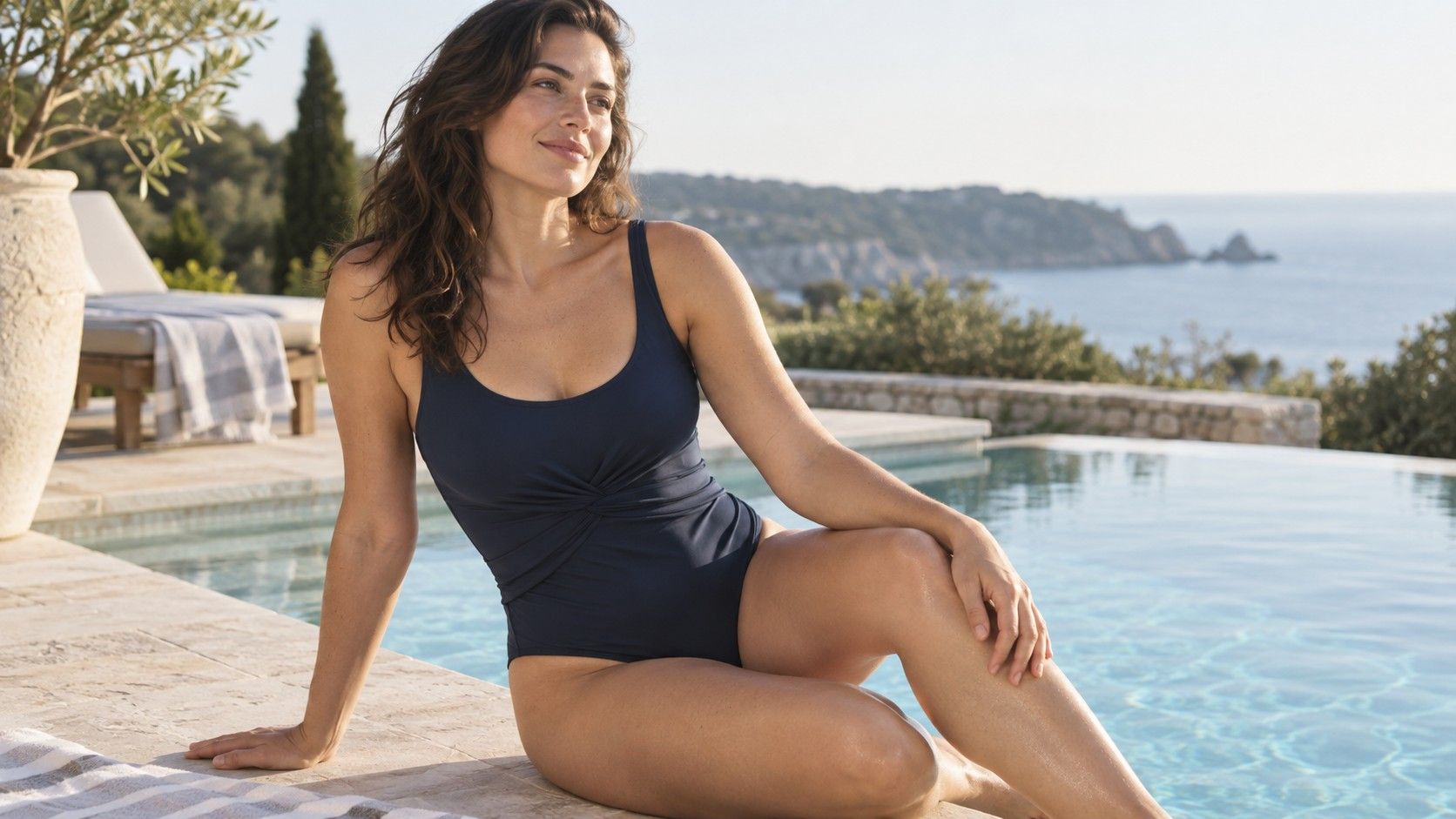
Good swimwear should survive a swim, a walk to the water, and the ordinary business of sitting on a towel without becoming the day’s main project. Advice about the best swimsuit for body type often starts with visual tricks and ends with a person trying to make their body look less present. A better swimsuit fit guide begins with comfort: support where you want it, coverage where you prefer it, and enough freedom to move without pulling, gaping, or digging in.
Choose movement and comfort before you choose a category
Before sorting through one-pieces, bikinis, or tankinis, decide what you will actually do in the suit. Floating in a hotel pool, swimming laps, playing in waves, paddleboarding, and reading on a beach chair put pressure on different parts of a garment. A high-fashion suit that stays still for a mirror photo may be useless when a wave hits from the side. If you plan to swim, roll your shoulders, squat, reach overhead, and take a few long steps in the fitting room. The suit should return to place without a private adjustment routine.
Body-shape terms can be a starting point for noticing proportions, but they are poor substitutes for this test. A person with a long torso may feel upward pull in a standard one-piece regardless of whether they identify with any named shape. Someone with a fuller bust may need a firmer underband even if the rest of the suit fits perfectly. Someone else may want a high back simply because straps sliding off during a swim are irritating. Swimwear for body shape becomes more useful once it includes these direct, specific needs.
Check support and coverage while the suit is dry
Wet fabric stretches, gets heavier, and can reveal a fit problem that was easy to ignore in a warm fitting room. For bust support, look first at the underband, not the cup padding. A band that is too loose rides up between the shoulder blades; one that is too tight leaves deep marks before you have reached the pool. Adjustable straps are helpful, but they cannot compensate for a weak band. If the suit uses removable cups, check whether they stay flat when you twist. Folded cups tend to migrate in water and create a lumpy shape that no amount of confidence is required to tolerate.
Coverage is personal, not a test of bravery. Pay attention to the leg opening from the front and side, then take a step up onto a low bench or chair. A cut that feels fine standing may shift at the crease of the leg when you sit. High-cut legs can lengthen the visual line of the body, but the right height is the one that does not rub or make you tug the fabric downward. At the back, use a full mirror if available and decide whether you want more, less, or simply more secure coverage. The answer can change with the activity and the setting.
Read one-piece fit through torso length, not through a label
A one-piece is often described as the safe choice, yet it is one of the most exacting garments to fit because the fabric connects shoulders, bust, waist, hips, and leg openings in one continuous path. If you feel the straps pulling your shoulders down or the neckline creeping lower as you stand upright, the torso is probably too short. Sizing up may add width without adding enough length, so look for long-torso versions, adjustable shoulder straps, a lower back, or a suit with a horizontal cutout that releases tension.
For a shorter torso, excess fabric can collect at the middle or a low scoop back can sit too close to the waist. A higher neckline, a firmer lining, or a suit with a slightly raised waist detail can make the fit feel more settled. This is not about creating a certain silhouette; it is about keeping the fabric in contact with the body so it does not fill with water or shift as you swim. A diagonal panel, a simple solid color, and a textured rib can all look good, but none of them fixes an incorrect length through the torso.
| Fit concern | What to test | Feature worth trying |
|---|---|---|
| Straps dig in | Raise arms and turn sideways | Adjustable straps with a firmer underband |
| One-piece pulls upward | Sit, bend, and take a long step | Long-torso cut or lower-back construction |
| Leg opening shifts | Walk and step onto a low surface | Different cut height or wider side seam |
| Top and bottom fit differently | Try each size separately | Bikini or tankini separates |
Use separates when one size cannot do every job
Bikinis and tankinis make sizing easier because the top and bottom do not have to agree on a single number. This is practical rather than indulgent. Many people need a different size at the bust and hip, and buying separates can solve that without forcing either area into a compromise. When trying a bikini top, fasten it on the loosest hook if it has one; the fabric and elastic will relax with use. For bottoms, make sure the side seams do not twist toward the front when you walk, which can be a sign that the cut is too narrow for your hip shape.
A tankini can offer the coverage of a longer top while keeping the convenience of two pieces. The common issue is lift: a loose hem may float up in the water, while a tight hem can roll at the waist. Test it by lifting your arms and gently pulling the fabric down once. If it immediately rides back up, choose a longer cut, a drawstring hem, or a design that lightly anchors at the side. A tankini is not automatically more modest or more comfortable; it is simply another construction with its own checks.
Pay attention to lining, seams, and the fabric against skin
The inside of a swimsuit often tells you more than the print. A fully lined front gives a little more opacity and can help a light-colored suit feel secure. Lining should lie flat, especially around the gusset and bust; bunched lining can chafe after ten minutes of walking. Look at the elastic around the leg and arm openings. A narrow, hard elastic may feel fine in a store but leave marks after an afternoon in salt water. Flatlock seams and soft binding are especially welcome if you plan to wear the suit under a rash guard or with shorts.
Fabric recovery matters too. Stretch the suit gently across the hip and let it go. It should return smoothly rather than remaining pale and strained. Very thin fabric can be comfortable in heat, but it may become transparent when wet or lose support quickly. Textured fabric can disguise water marks and feel less clingy, while a smooth performance fabric is often easier for swimming. Neither is superior in every case. The question is whether the material supports the activity you intend to do and feels acceptable on your skin after it has been wet for an hour.
Test the suit before removing the tags
At home, wear the suit over clean underwear and recreate a small version of your day. Sit on a chair, reach for a shelf, walk upstairs, and bend to pick up a towel. Put a loose shirt or cover-up over it if you expect to wear one, since straps and necklines can shift under another layer. Take a photo from the front and side in daylight, not to look for defects but to see where the suit has settled after movement. A mirror snapshot after thirty seconds is less honest than the view after ten normal minutes.
If something is uncomfortable while the fabric is dry and new, it rarely becomes charming after chlorine, sunscreen, heat, and a wet towel. Return it without treating that as a personal failure. The most useful answer to what is the best swimsuit for body type is often a boringly sensible one: the suit whose straps stay up, whose fabric stays put, and whose coverage lets you pay attention to the water instead of the garment.