Apple body shape clothing is often discussed in language that makes a body sound like a problem to minimise. That is not especially helpful when the actual issue is a top that pulls at the middle, trousers that cut in after an hour, or a dress that looks fine until you sit down. This guide starts with comfort and proportion: choose clothes that give the midsection room, keep the shoulder line honest, and let you decide whether you want a defined waist, a clean column, or something in between.
What the apple label usually describes
An apple or round body shape is a shorthand for a fuller-looking midsection relative to the hips, often with a good deal of visual strength in the shoulders, bust, or legs. It is not a medical category, and it does not tell you your size, height, or personal style. Some people with this proportion have long legs and a soft waist; others have a broad ribcage, a fuller bust, or a torso that varies with the day. The useful observation is where fabric needs ease, not whether you match an illustration.
Before deciding that an item is “not flattering,” identify what feels off. If a blouse pulls across buttons, the issue is probably bust or back width. If a waistband rolls while sitting, it may be the rise or the elastic construction. If a dress appears to hang from the bust and then catches at the stomach, it may simply lack enough fabric through the front. Those are garment problems, and they are easier to solve than a vague instruction to dress differently.
Start by checking shoulder fit. A shoulder seam that lands too far down can make a top look limp, while one that pinches limits movement and makes the neckline sit badly. Once the shoulders fit, the rest of the garment has a better chance of hanging cleanly. It is an unglamorous detail, but it is the reason one relaxed shirt looks polished and another looks as if it has given up before breakfast.
Why ease at the waist changes everything
Ease allowance is the small amount of extra space built into a garment so that it can move with you. In apple body shape clothing, it is often the line between a useful piece and a piece you keep adjusting. A waist seam can be lovely, but it should sit where you can breathe and bend. If the seam is forced to do all the defining, fabric may bunch above it and pull below it. A looser seam, a gentle front tuck, or a dress that skims rather than cinches can look more considered.
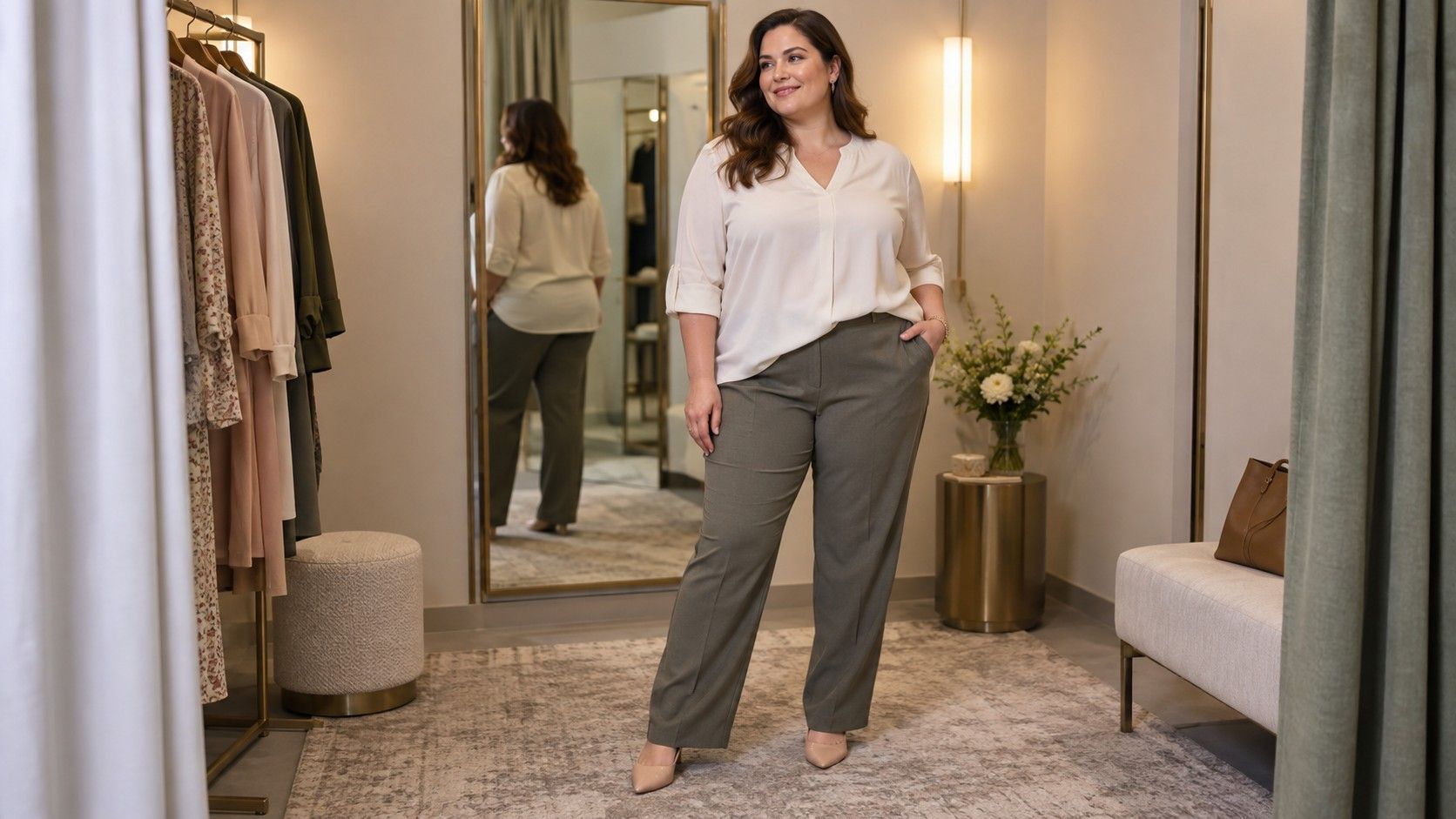
Try the seated test before you are persuaded by a mirror. Sit in the fitting room chair for a minute, cross one leg, reach into an imaginary bag, and stand again. A waistband that stays level, a button placket that remains closed, and a hem that falls back into place are worth more than a clever styling trick. A garment does not have to be oversized to be comfortable; it just needs enough room in the part of the body that does the most moving.
Watch for clingy fabric paired with too little structure. Thin jersey can be comfortable but may grip the midsection and show the edge of every underlayer. A medium-weight knit, woven viscose with a lining, cotton poplin, or a soft ponte fabric often creates a smoother line without becoming stiff. If you love a thin top, layering it under an open shirt or jacket may give it the support it lacks alone.
Tops and layers that do not spend the day pulling
An open neckline is useful because it creates a vertical space near the face, but it is only one option. A V-neck, split neck, open collar, or scoop neck can work if it feels secure and suits the occasion. A crew neck can also look excellent when the top has a clean shoulder, a substantial fabric, and a hem that does not cling. The point is to choose a neckline that gives the top a clear starting point instead of adding bulk at the throat.
For a top worn untucked, look at hem position. The most awkward length is often the one that ends precisely at the fullest part of the midsection and grips there. A shorter top that meets a high-rise trouser, or a longer one that falls below the hip with enough room, may feel easier. A curved hem can soften the transition, while side slits prevent the front from hitching upward. Check all of this while walking; a top that stays put for one posed photo can still become irritating by the first coffee queue.
Open layers are practical rather than magical. A blazer, overshirt, long vest, or lightweight cardigan creates two vertical lines without requiring you to hide anything. Choose the length according to the outfit underneath: a cropped jacket can work with high-rise trousers, while a longer layer can make a simple column of dress and tights feel intentional. Make sure it has room through the upper arm and back. A jacket that fits only while your arms hang still is not a jacket you can live in.
Compare dresses and trousers in a fitting room
Straight trousers are a reliable baseline because they fall from the hip without narrowing too sharply at the ankle or adding a wide sweep of fabric. A gentle tapered leg can work if there is enough ease through the thigh. Wide-leg trousers can also be comfortable, especially in a fluid fabric, but inspect the front pleats: deep pleats that spring open under the stomach can add volume you did not choose. A flat-front style with a side zip or a smooth elastic back is often easier.
| Garment | Fitting-room check | A practical benefit |
|---|---|---|
| Straight trouser | Waist stays level when seated; front lies smooth | Creates an uncomplicated line to balance layers |
| Soft wide-leg trouser | Fabric falls from the hip instead of opening at pleats | Gives movement without gripping the leg |
| Shift or column dress | Enough front length while sitting; shoulders do not slide | Offers ease without a forced waist seam |
| Wrap-style dress | Overlap remains closed when you bend or walk | Can create adjustable definition when the fabric is stable |
For dresses, notice where the fabric catches. A shift dress needs enough room over the bust and stomach to move independently of your body. A column dress often looks better with a seam, texture, or open layer that breaks the line slightly. Empire seams can be comfortable, but try several: one that sits too high may make the dress feel like it is hanging from the bust. A seam just below the natural bust with a skirt that has real room can be a calmer alternative.
Do not dismiss dresses with waist definition, either. A tie can be loose and placed slightly to one side; a belt can sit at the narrowest comfortable point rather than the narrowest theoretical point. The goal of how to dress apple body shape is not to erase the middle. It is to prevent the garment from pinching, twisting, or demanding constant negotiation.
Use colour and texture as design choices, not camouflage
Column dressing means keeping the top and bottom in related colours, then adding contrast through a jacket, shoe, or accessory. It can lengthen the eye’s path and makes getting dressed quickly much easier. Navy trousers with a navy knit, black jeans with a charcoal T-shirt, or olive separates in slightly different tones all work. The colours need not match exactly; a little difference in texture keeps the outfit from looking like a uniform.
Dark colours are optional, not a requirement for round body shape outfits. A pale blue shirt, red cardigan, patterned dress, or cream trouser can be as successful as black if the fabric and fit are right. If you prefer print, look at its scale from a few steps away. A print can be lively without becoming busy, while a large high-contrast pattern may dominate an outfit more than you want. Neither is wrong; it is simply a choice about attention.
Texture deserves the same consideration. Smooth ponte, denim, cotton twill, and fine wool tend to skim. Very shiny satin and clingy ribbed knit draw more attention to every curve and may need an underlayer or a relaxed cut. Touch the fabric, scrunch it in your hand, and see whether it recovers. A material that wrinkles deeply or clings through static electricity can make a good shape feel difficult by mid-afternoon.
Keep the pieces that work in ordinary life
Use a three-view test before removing tags: front, side, and back. A phone photo in daylight is more honest than a high changing-room mirror. Then test the garment with the bra, underwear, bag, and shoes you normally wear. The perfect dress with seamless shapewear you never use is not actually the perfect dress. Clothing should support your day, not create a new maintenance routine.
It also helps to make notes about successful cuts rather than only failed ones. Perhaps mid-rise straight jeans with a smooth front work every time, or a size larger in woven shirts gives the shoulders and bust enough room. Those details become a personal guide more valuable than any fixed apple body shape rule. When a garment gives you ease through the midsection and still feels like your style, it has done its job.