Getting dressed with a short torso is less about correcting a body and more about deciding where you want an outfit to pause. A waistband, shirt hem, jacket edge, and neckline all compete for that job. I have found that the outfits that look most convincing are not the ones that stretch the body into a diagram; they are the ones that leave enough breathing room around the waist and still let you move, sit, and eat lunch without negotiating with your clothes.
First, separate a short torso from being petite or having long legs
A short torso describes the distance between the base of the neck and the natural waist relative to the rest of your frame. It is not a height category, and it is not a verdict on what you can wear. Someone tall can have a compact waist area; someone short can have a visibly long torso. The useful check is a mirror, a plain fitted top, and trousers with a clear waistband. Notice where the waistband lands between your bust or ribs and hips, rather than judging from a phone photo taken at waist height.
Try the same top untucked, half-tucked, and fully tucked with the same trousers. If the full tuck makes the upper body feel abruptly compressed while the half-tuck feels relaxed, that is useful information, not a rule to obey. Camera lenses exaggerate this issue, especially a close selfie. Step back, use a timer, and look at the outfit in motion. A short torso can look beautifully balanced in clothes that would be labelled "wrong" by a simplistic proportion chart.
Choose trouser rise by comfort before visual theory
Rise is the distance from crotch seam to waistband, and it changes the visual starting point of the legs. Very high-rise trousers can lengthen the leg line, but on a short waist they may use up the space where a shirt, belt, and jacket need to coexist. The result can feel neat when standing and oddly crowded when seated. Mid-rise trousers are often the quiet middle ground: they give a defined waist without pushing it toward the ribs.
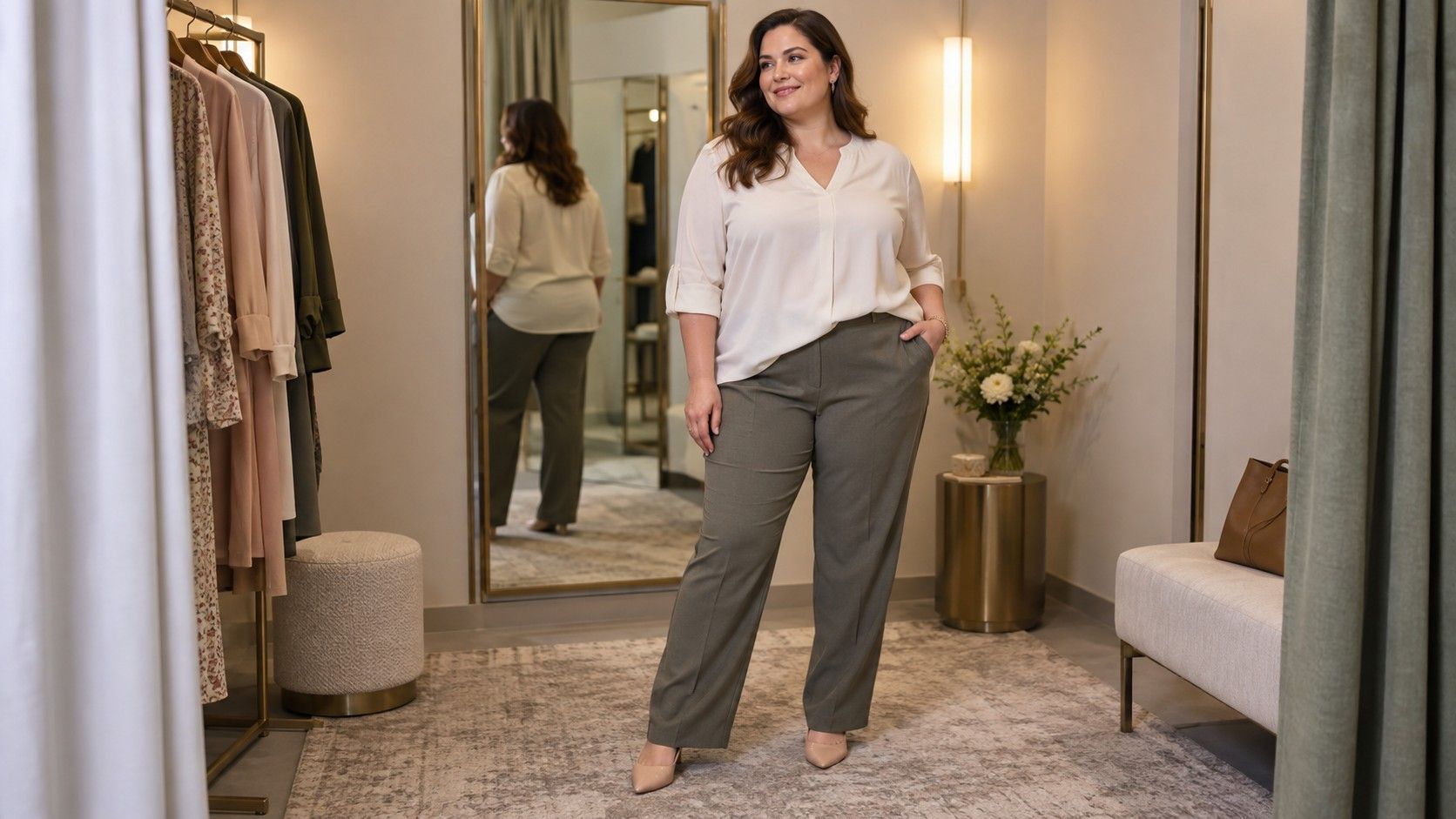
In a fitting room, sit on a bench, raise both arms, then take a full stride. The waistband should not fold into the lower ribs or pull at the front zipper. If it does, do not assume a bigger size solves the problem; the rise shape may simply be too tall for your torso. A softer waistband, a slightly lower front rise, or a pair with room through the hip can make the same outfit look less engineered.
| Rise to test | What it can do | Watch for |
|---|---|---|
| Low rise | Leaves more visible space above the waistband | May shift or gap when sitting |
| Mid rise | Creates a calm break without crowding the ribs | Check that the back rise still feels secure |
| High rise | Defines the waist and lengthens the lower half | Can make a short waist feel boxed in |
Use tucks and belts as adjustable tools
A full tuck is not the only way to show shape. A French tuck, where only a small front section is tucked, creates a vertical opening down the front and lets the sides fall naturally. This works well with a knit that is thin enough not to bunch at the waistband. With a crisp cotton shirt, try leaving the lowest button open over a smooth camisole or tank; the vertical line is often more useful than a perfectly exposed waist.
Belts deserve the same suspicion as any universal styling advice. A wide, high-contrast belt draws a strong horizontal line, which may be exactly the effect you want with a simple dress, but it can divide a compact midsection into two tight blocks. A belt close in colour to the trousers, or a narrow belt partly hidden by a relaxed top, keeps the function without shouting about the waist. Check it after thirty minutes of normal movement, not only under fitting-room lighting.
Let necklines and open layers create room above the waist
A modest V-neck, a soft scoop, or an unbuttoned shirt creates a vertical direction that can make the upper half feel less crowded. The goal is not cleavage or a deep neckline; even a small opening at the collarbone changes the eye's route through an outfit. By contrast, a thick crew neck combined with a high waistband and a short necklace can stack several stopping points in the same small area. None is bad alone, but together they can feel busy.
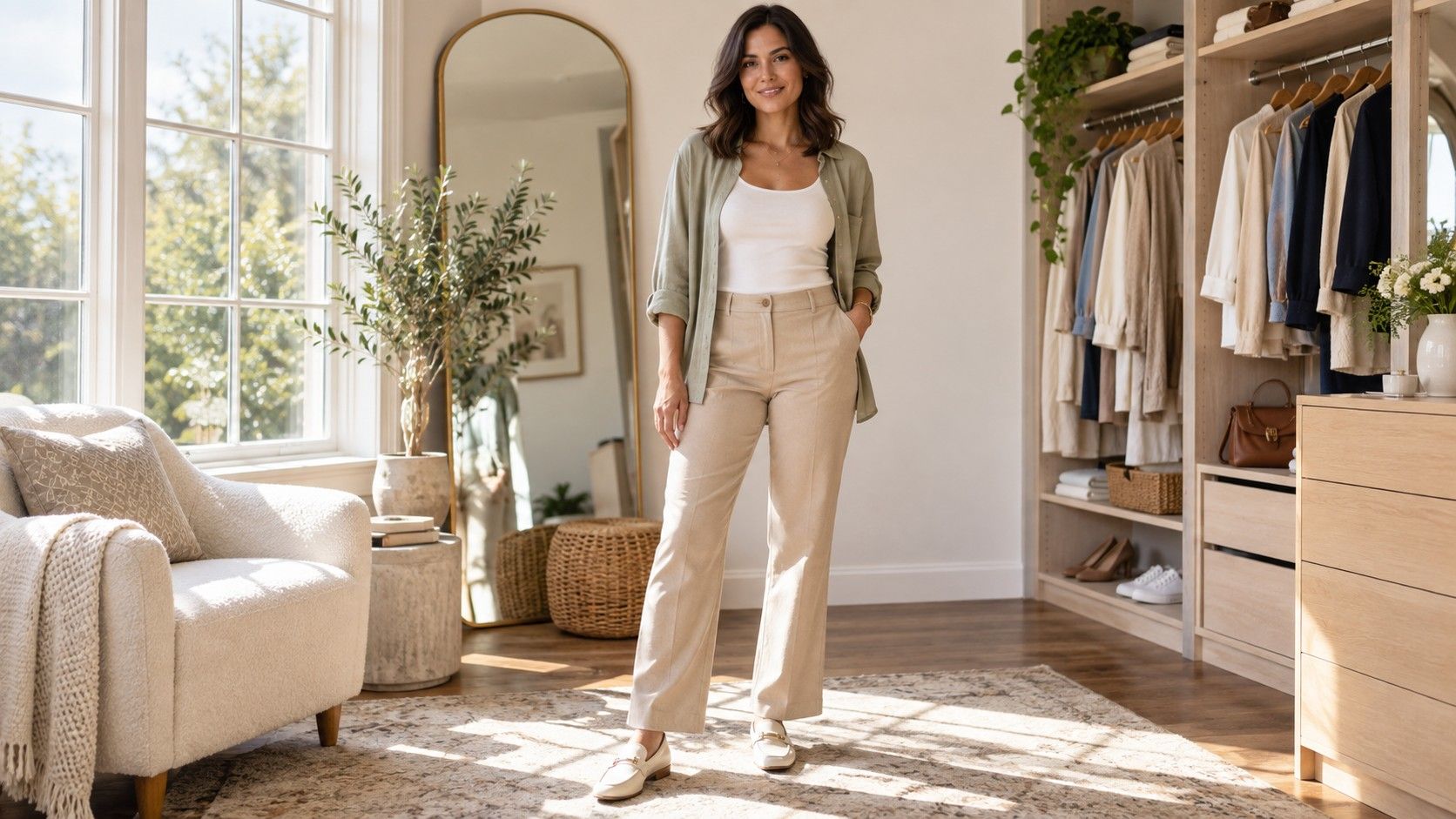
Open layers are similarly practical. A cardigan, overshirt, or blazer worn open forms two long columns at the front. For short torso outfits, choose a layer that ends either clearly above the waistband or low enough to pass the hip, rather than stopping at the widest point. A thin cropped cardigan over a higher-rise skirt can work because it reads as an intentional top. A stiff jacket ending one inch below a crowded waistband often reads as an accidental compromise.
Test dress and jacket lengths in ordinary situations
Dresses remove the trouser rise question but introduce waist-seam placement. An empire seam may sit too high for some people and feel costume-like; a dropped waist can be comfortable but may erase shape. A natural or slightly lowered waist seam is worth trying first. Look for fabric that drapes past the seam rather than clinging exactly where the torso ends. A wrap dress can be adjustable, though a bulky tie at the narrowest part of the torso can add more interruption than it removes.
With jackets, put your hands in your pockets and turn sideways. A cropped denim jacket that ends well above the waist can preserve a long visual line underneath. A blazer that covers part of the hip can do the same, especially over a low-contrast top and trousers. The tricky length is the almost-cropped jacket: it lands right on the waistband, adds a hard horizontal seam, and gives you no room to decide whether to tuck the top.
Keep the outfit from becoming a collection of fixes
The easiest mistake when learning short waist styling is applying every proportion trick at once: high rise, tucked shirt, cropped jacket, belt, pointed shoes, and a deep V-neck. The outfit may follow a checklist and still feel like a costume. Pick one main move. If the trousers have a high rise, let the top be loose or leave the jacket open. If the belt is the point of the look, choose a quieter neckline and a simpler hem.
It also helps to keep a small record of combinations that worked on real days: jeans and an untucked fine knit for errands, a mid-rise skirt and short cardigan for dinner, trousers and an open blazer for work. Fit changes between brands, seasons, and even washes of denim. Personal proportion is a starting observation, not a permanent assignment. The best short torso outfits are the ones you stop thinking about once you leave the mirror.